
Premium Insights for Homeowners in Nunawading, Box Hill, Mitcham & Eastern Melbourne
Engineered flooring remains one of the leading choices among Melbourne’s eastern suburbs thanks to its natural beauty, reliable stability, and compatibility with modern home design. But a question that consistently appears searches—and one that Dex Flooring customers ask daily—is:
Is Engineered Flooring waterproof?
The short answer is no—engineered flooring is not fully waterproof. But that does not mean it performs poorly with moisture. In fact, depending on construction quality, wear‑layer technology, installation method, and household conditions, engineered timber can offer excellent water resistance, making it suitable for most dry areas of Melbourne homes.
This article is written specifically for Dex Flooring customers in Nunawading, focusing on how engineered floors behave in real Melbourne homes, how they compare against hybrid and vinyl floors, and how to protect them long‑term.
Understanding Engineered Flooring
Engineered timber flooring is crafted from multiple layers designed for structural stability and predictable performance in environments like Melbourne—where temperatures fluctuate and humidity levels shift throughout the year.
Components of engineered flooring:
- Real hardwood veneer (top layer) – provides the authentic timber appearance.
- Stabilising multi‑ply or HDF core – improves durability and reduces movement.
- Backing layer – balances the board and supports dimensional stability.
This construction dramatically reduces expansion and contraction compared to solid hardwood—but it does not make engineered timber waterproof.

Bring Style & Durability to Your Floors
Discover modern flooring that perfectly matches your lifestyle
Our experts at Dex Flooring Nunawading are ready to help you choose your dream floor
Is Engineered Flooring Waterproof?
Google Australia results show repeated searches for:
- is engineered flooring waterproof
- is engineered floor water resistant
- best waterproof engineered flooring
These searches indicate homeowners want clarity—not marketing jargon.
✔ Waterproof? No
✔ Water‑resistant? Yes, very often
Engineered flooring is treated with sophisticated coatings such as:
- UV‑cured acrylic lacquer
- Aluminium‑oxide reinforcement systems
- Hydrophobic top‑layer treatments
These protect the surface effectively—but the core remains vulnerable to prolonged moisture.
How Engineered Flooring Responds to Moisture
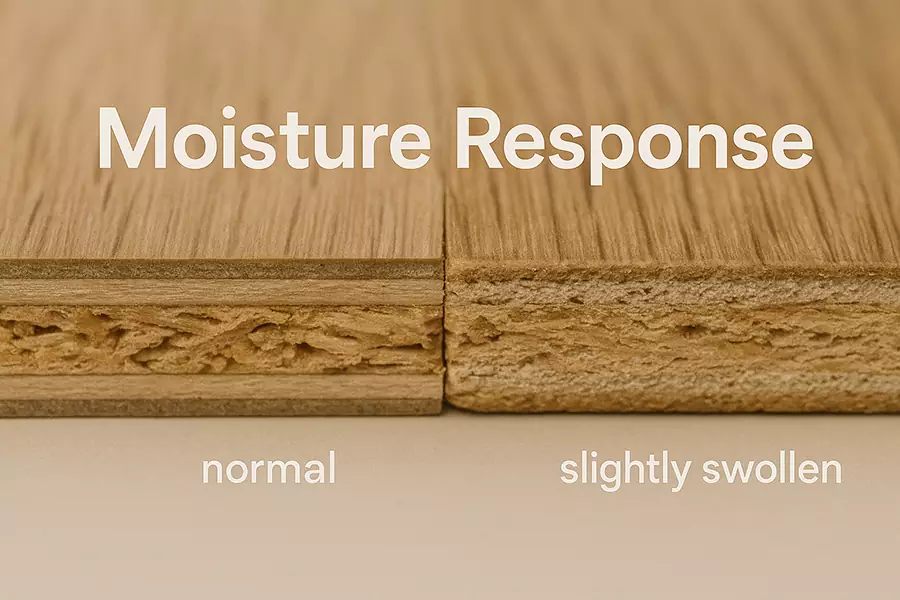
Water affects engineered timber differently depending on exposure time and board composition.
Short‑term exposure (seconds–minutes)
- Water beads on the surface.
- No structural change.
- Safe when wiped quickly.
Moderate exposure (minutes–hours)
- Moisture reaches micro‑gaps.
- Edges may swell slightly.
- Veneer may start absorbing moisture.
Long‑term exposure (hours–days)
- Core swelling becomes visible.
- Boards may cup or peak.
- Veneer can delaminate.
- Joins may permanently deform.
Is Engineered Flooring Water‑Resistant?
Yes—high‑quality engineered flooring is designed to resist everyday moisture levels. Dex Flooring supplies engineered products specifically chosen for Australian conditions.
Water resistance depends on:
- Board thickness
- Veneer species and hardness
- Coating system
- Core type (HDF vs plywood)
- Installation method
Engineered flooring can handle:
✔ Small spills wiped promptly
✔ Damp‑mop cleaning
✔ Everyday humidity
✔ Kitchens with proper care
✔ Air‑conditioned or climate‑controlled homes
Engineered flooring cannot handle:
❌ Standing water
❌ Steam mops
❌ Bathroom or laundry installation
❌ Plumbing leaks or flooding
Best Moisture‑Resistant Engineered Flooring Options
Based on performance trends and customer outcomes in Melbourne, these engineered board types show the strongest moisture resistance:
-
HDF‑core engineered boards
High‑density fibreboard offers superior swelling resistance compared to basic plywood cores.
-
Multi‑ply hardwood core systems
More layers = more stability + more predictable moisture behaviour.
-
Aluminium‑oxide coated veneers
Extremely durable, scratch‑resistant, and moisture‑tolerant.
-
Waxed or hydrophobic edge locking systems
Slow moisture penetration into join lines.
Where Engineered Flooring Works Best in Melbourne Homes
Engineered flooring is ideal for:
- Living rooms
- Dining areas
- Bedrooms
- Hallways
- Apartments
- Family rooms
- Study/office areas
Suburbs like Nunawading, Blackburn, Forest Hill, Ringwood, Box Hill, and surrounding areas often feature engineered flooring in modern renovations due to its combination of performance and natural aesthetics.
Where Engineered Flooring Should NOT Be Installed
Avoid engineered flooring in:
- Bathrooms
- Toilets
- Laundries
- Mudrooms
- Areas prone to flooding
- Under sinks without mats
Moisture exposure in these locations exceeds the tolerance of even high‑quality engineered products.
How to Protect Engineered Timber in Your Home
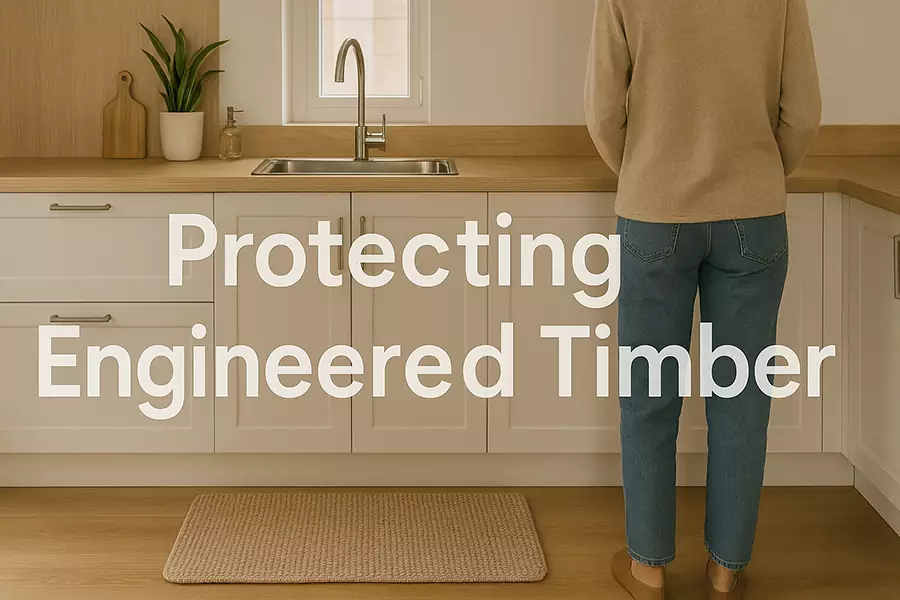
Dex Flooring customers benefit greatly from simple preventative care strategies.
-
Wipe spills immediately
Prevents moisture penetration through micro‑gaps.
-
Place mats in kitchens and entryways
Ideal for busy homes where spills are common.
-
Maintain humidity stability
Aim for 40–60% relative humidity.
-
Avoid steam mops
Steam forces moisture into the core.
-
Use proper vapour barriers on concrete slabs
Absolutely essential for Melbourne homes built on slab foundations.
Installation Matters: Key Factors Affecting Moisture Resistance
✔ Vapour barriers
Prevent rising moisture from concrete subfloors.
✔ Correct underlay selection
Acoustic, rubber, or moisture‑proof underlays improve performance.
✔ Professional installation
Improper clicking or locking leaves gaps that water can enter.
✔ Expansion gaps
Allow expansion and prevent buckling.
✔ Controlled indoor climate
Melbourne’s changing seasons make this extremely important.
Water Resistance Comparison Table
| Feature | Engineered Timber | Hybrid Flooring | Vinyl Flooring |
| Waterproof | ❌ | ✔️ | ✔️ |
| Water Resistant | ✔️ | ✔️ | ✔️ |
| Suitable for Kitchens | Limited | ✔️ | ✔️ |
| Suitable for Bathrooms | ❌ | ✔️ | ✔️ |
| Handles Spills | Moderate | High | High |
| Natural Timber Look | ✔️ | ✔️ | ✖️ |
FAQs —
-
Is engineered flooring suitable for Melbourne’s Eastern suburbs?
Yes—especially in Nunawading and surrounding areas.
-
Can engineered flooring handle small kitchen spills?
Yes, as long as spills are wiped promptly and mats are used near sinks.
-
Does engineered flooring swell when wet?
It can swell at the edges if moisture sits for too long.
-
What type of engineered flooring handles moisture best?
Boards with hydrophobic coatings, HDF cores, and sealed locking systems perform best.
-
Is engineered flooring better than hybrid for wet areas?
No—hybrid and vinyl are fully waterproof; engineered flooring is not.
Ready to Transform Your Home with Engineered Timber?
Dex Flooring helps Melbourne homeowners choose flooring that balances beauty, durability, and performance. Whether you need engineered timber, hybrid, or vinyl, our expert team guides you every step of the way.
Visit our Nunawading showroom and discover flooring designed for Melbourne living.