

Hybrid Flooring is often selected for its balance of strength, appearance, and ease of maintenance. Despite this versatility, correct performance depends heavily on following a clear set of rules. These hybrid flooring installation rules determine where the flooring can be used, how it must be allowed to move, and what methods should be avoided during installation.
This article explains the most important installation rules and limitations in a practical, easy-to-follow way, focusing on decisions that must be made before installation begins.
Why Installation Rules Matter for Hybrid Flooring
Hybrid flooring is engineered as a floating floor system. This design allows the entire floor to expand and contract together in response to indoor temperature and humidity changes.
Installation rules exist to support this natural movement. When the floor is restricted by glue, tight edges, or unsuitable environments, stress builds within the planks. These issues usually appear after installation, making early planning essential.
Can Hybrid Flooring Be Used in Bathrooms?
Bathrooms raise specific concerns due to moisture exposure. Hybrid flooring features a water-resistant core, which makes it more tolerant of occasional moisture than many other flooring options.
However, hybrid flooring is best suited to bathroom dry zones only. Areas around vanities or outside enclosed showers are generally more appropriate. Continuous exposure to water, poor ventilation, or standing moisture increases the risk of damage beneath the floor.
Careful edge sealing and moisture control are essential when hybrid flooring is used in any bathroom space.
Does Hybrid Flooring Need Expansion Joints?
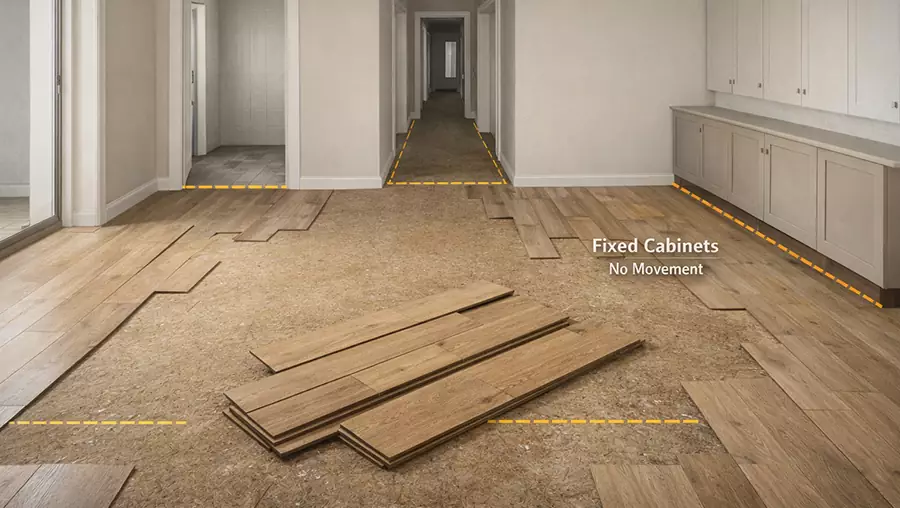
Expansion joints are mandatory for all hybrid flooring installations. As a floating floor, hybrid flooring must be free to move.
Small expansion gaps must be left around the perimeter of rooms, door frames, cabinetry, and fixed structures. These gaps absorb natural movement and prevent pressure from building across the floor. Filling or fixing these gaps restricts movement and can lead to lifting or joint failure.

Bring Style & Durability to Your Floors
Discover modern flooring that perfectly matches your lifestyle
Our experts at Dex Flooring Nunawading are ready to help you choose your dream floor
Do You Need Scotia for Hybrid Flooring?
Scotia is commonly used to cover expansion gaps, particularly in renovation projects. Its use depends on how the perimeter of the floor is finished.
If skirting boards remain in place, scotia provides a neat way to conceal expansion gaps without removing wall finishes. If skirting boards are removed and reinstalled after the flooring is laid, scotia may not be required. In all cases, the expansion gap beneath must remain clear.
Do You Glue Hybrid Flooring to the Subfloor?
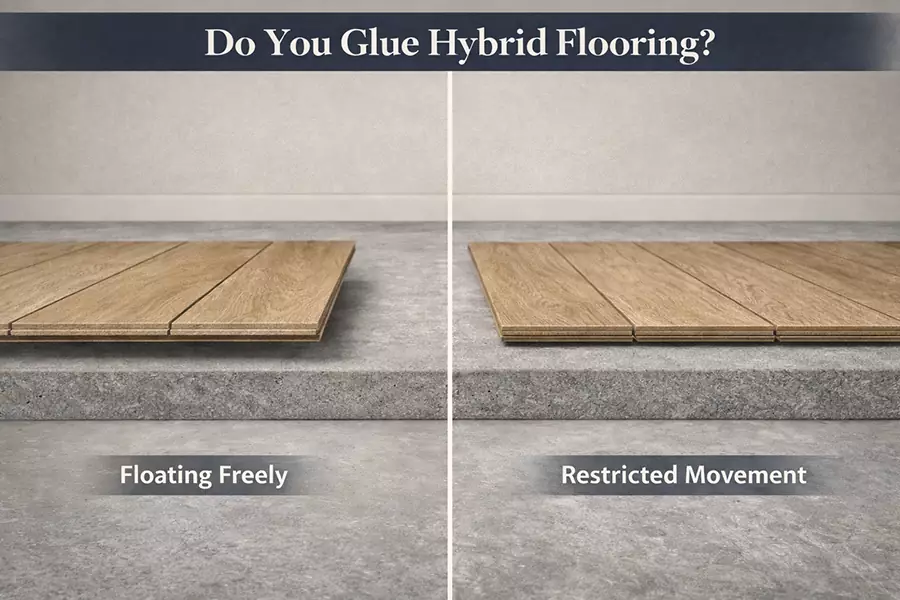
Hybrid flooring should not be glued to the subfloor. The floating system relies on free movement across the entire surface.
Gluing restricts this movement and transfers stress into the locking joints. Over time, this can cause separation or distortion. Adhesives are typically limited to trims or transitions where approved by the manufacturer.
What Does “How to Do Hybrid Flooring” Mean?
In most cases, this refers to understanding the right conditions and preparation rather than learning physical installation steps.
Doing hybrid flooring correctly means confirming room suitability, allowing for expansion, managing moisture exposure, and choosing compliant finishing methods. These factors have a greater impact on long-term performance than installation speed or technique.
Core Hybrid Flooring Installation Rules
| Installation Rule | Purpose | Risk If Ignored |
| Floating system | Allows natural movement | Buckling or joint stress |
| Expansion gaps | Absorbs environmental change | Lifting or separation |
| Moisture control | Protects the core | Swelling or damage |
| Proper finishing | Keeps gaps clear | Noise or visual defects |






Frequently Asked Questions
1) Can hybrid flooring be used in bathrooms long term?
Hybrid flooring can be used in controlled bathroom dry zones where moisture exposure is carefully managed.
2) Does hybrid flooring always need expansion joints?
Yes, expansion gaps are required for all floating hybrid flooring installations.
3) Do you need scotia for hybrid flooring in renovations?
Scotia is often used when skirting boards remain in place and expansion gaps need to be concealed.
Final Thoughts
Hybrid flooring installation rules and limitations are designed to protect the floor after installation. By selecting suitable rooms, allowing for movement, controlling moisture, and avoiding glued installation, hybrid flooring can perform reliably and maintain its appearance over time.